Showing posts with label carbon tax. Show all posts

Sunday, November 16, 2008

Carbon crash hits Europe's emission trading scheme

November 06, 2008
From The Australian

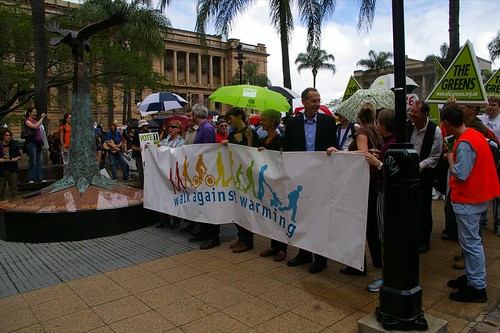
WalkAgainstWarming200860
This is why we should have a straight carbon tax or carbon rationing instead of relying on the ETS Market system which is just capitalism which has caused the problems in the first place.

A Carbon Tax is where a GST / VAT / .. type tax at some percent is applied calculated on the cost it will take to repair that Carbon that has been emmitted in manufacturing, transporting etc... the product in question. It would be calculated and not a plucked figure.

Carbon rationing is even better where we work out how much carbon per person we're allowed to emit to remain sustainable. It will involve some credit card type arrangement. If you use more than your allocation you can buy from someone who didn't use as much.

Both are politically difficult to implement in our current capitalist societies.


WHILE you were distracted by crashing banks and clashing US senators, you may have missed a small environmental earthquake.

The price of carbon has collapsed.

In only three months, life has become a lot cheaper for polluters. The financial cost of warming the planet has plummeted in Europe's emissions trading system (ETS) and the effectiveness of such a volatile market mechanism in curbing carbon is being questioned.

You may recall that the ETS is a mechanism to encourage businesses to reduce their carbon output. Europe's larger companies are allocated permits to emit CO2, and these allowances, called EUAs, can be traded on exchanges.

Companies that emit less CO2 than their allocation can sell EUAs for cash, but inefficient polluters must buy EUAs or face financial penalties.

The idea is that a shortfall in EUAs allocated by governments will cause the carbon price to rise, stimulating investment in carbon reduction.

It's a market solution to pollution, but this carbon market is showing a distressing tendency to behave like most financial markets -- hysterically. In July, the right to spew out one tonne of CO2 from a chimney would have cost a power generator E29.33, but yesterday it could be bought for only E18.25 ($34.14).


...

Read the article.

Read More......

Wednesday, August 13, 2008

Environmental Cost of Shipping Groceries Around the World

April 26, 2008
From New York Times

...


Veges in a Parisian Market


Box Fresh Organics, a popular British brand, advertises that 85 percent of its vegetables come from the British Midlands. But in winter, in its standard basket, only the potatoes and carrots are from Britain. The grapes are South African, the fennel is from Spain and the squash is Italian.

Today’s retailers could not survive if they failed to offer such variety, Mr. Moorehouse, the British food consultant, said.

“Unfortunately,” he said, “we’ve educated our customers to expect cheap food, that they can go to the market to get whatever they want, whenever they want it. All year. 24/7.”


...

Read the article.

Read More......

Thursday, May 10, 2007

Blitz spirit needed to face threat of climate change

Wednesday May 9, 2007
From Guardian (UK)

The government's climate change bill has nowhere near the vision commensurate to the scale of the threat. The Stern Review has already set out the facts: we can carry on as we are, leading to a global economic collapse, or we can try to halt the worst ravages of climate change by stabilising CO2 at 450 parts per million (ppm) in the atmosphere, or we can aim to stabilise CO2 at 500-550 ppm.

...

Read the article.

Read More......

Wednesday, February 14, 2007

Suzuki Climate Interview

February 12, 2007
From ZMag.com (Canada).

For the first time in a long time, the environment is getting some major attention, or at least major lip-service, from the powers that be, nationally and internationally.

To try and "turn concern into concrete action" David Suzuki, one of Canada's leading environmentalists, will be crossing the country in February on a 50 city tour, speaking with communities on the theme 'what would you do if you were Prime Minister.'

David Suzuki is author of more than 40 books including From Ape to Super Species and the Sacred Balance. He has a PHD in Zoology from the University of Chicago and was named one of the ten greatest Canadians in CBC's competition.

The following is what transpired when Suzuki spoke with ZNet columnist Chris Arsenault by phone from his office in Vancouver just before deadline last week.

Chris Arsenault: You've been talking about the environment and climate change issues for the last 40-some years. Why do you think world government and business leaders are finally starting to pay attention?

David Suzuki: The Federal government has gone through a change of heart because the public has registered this issue so high in the polls. People know there's something screwy going on with weather and climate.


Here in British Columbia, we've had incredible extreme weather. Storms destroyed 3,000 trees in Stanley Park. We have forests turning red from the pine beetles that aren't killed by cold winters. Tofino, in the rainforest, was shut down in the middle of tourist season because they didn't have clean water. All these things are coming together, and people are freaking out.

In 1988, I want to remind people, the environment was the number one issue.

That's why Brian Mulroney became the 'environmental Prime Minister', because the public was so worried. Very shortly after that, the economy became a concern because it went into a dip and everyone was worried about jobs. The economy is doing very well now so we can look at other things like health and the environment.

CA: If we are talking about the economy, the Alberta tar-sands oil industry is a major engine of growth and Canada's biggest polluter. How are we going to take on an industry with such political, regional and economic clout?

DS: Even [former reactionary Reform Party leader Preston] Manning, is saying that you can't just act as if air and water are free. It takes a huge amount of energy just to melt the tar sands and then you have to use a huge quantity of water. That's a cost which has to be internalized. Right now the oil industry is getting away scotch free. They aren't having to pay for the air and water they use.

If the industry were paying for the pollution, I don't think the tar sands would be economical right now. We've already subsidized the tar stands to the tune of billions of dollars. Those costs have been externalized; they should be internalized by the companies who are doing the polluting.

The reality is what we need right now is strong Federal leadership to set standards, concrete targets and legislate timelines to meet those targets.

We've got to stop subsidizing the fossil fuel industry. They're making windfall profits and we're still subsidizing them to the tune of billions of dollars. It doesn't make any sense. Take that money and use it for green energy, rapid transit and all sorts of other good stuff.

...

Read the article.

Read More......
Sunday, February 11, 2007

The biggest game on earth

Perhaps we are getting somewhere. I believe that Paul has painted a rosier picture than what is really being talked about in society. I've read a number of articles over the last couple days painting a picture of denial. One in the Australian yesterday yesterday used evidence from the IPCC report to say that ocean level rises would "only be" 50cm instead of Al Gore's pessimistic 6m that would wipe out New York. I believe that that figure of 50cm is the IPCC's expectation of up to 2050. Beyond that we could be looking at 6m. My point is, that I read a number of articles where people now admit Climate Change is real, but that the doomsday people are exagurating how bad it will be, and that there should be no need to worry about losing our currently beautiful lifestyles. We hate to say we told you so, and as vindication to us, we already have.

I'm going to copy in the entirety of this article since I read somewhere that The Australian is going to start charging for online access to their materials. This ofcourse will make it difficult to site their information online. I think this is a fucked mentality and a bad business decision. I won't pay for subscription - there are plenty of other news sources out there.


February 10, 2007
From The Australian.

Climate-change politics is a sleeping giant that has arisen, writes Paul Gilding.

LIKE many deeply involved in the climate change issue for the past 20 years, I've been feeling disoriented. Suddenly it's a top-order political issue, nationally and globally, and arguably the defining issue of our times. Carbon trading is just around the corner, conservative green politics has arrived and for consumers, paying for your carbon will soon be normal operating procedure.
In 30 years' involvement in social and environmental issues, I have never seen an issue move so fast or so dramatically as did this one in the spring of 2006. Nor have I been so excited at the potential for rapid, far-reaching change. So what happened and, more important, what happens now? Is this a genuine global environmental spring or is this some kind of weird drought-influenced aberration that will pass and normal transmission will then return?

And carbon pricing - what does it mean and how will it work? What are the implications for Australia and for key industries? With the arrival of "conservative green", will politics in Australia be the same again?

Let's start with the science which is worth revisiting briefly for one reason. Unlike most other market and political questions, where the uncertainties of human behaviour, technology and political trends make predicting the future a dangerous though interesting activity, climate change is different.

It is driven by science, by physical realities, like the heat-trapping nature of greenhouse gases. We put more CO2 pollution in the atmosphere and more heat will

be trapped. If it gets hotter, the climate will change.

So as the science became accepted over recent years, the direction of the market became crystal clear. People, including some titans of industry, thought it through. They realised if this relationship is a fact, and the effects we see are already significantly negative, such as our hopefully soon-to-break drought, then the future suddenly looks deeply unstable, potentially catastrophically so. The conclusion: time to act.

Enter John Howard. The point that marked the end of the climate-change winter in Australian politics was the Prime Minister's long interview on Four Corners on August 28 last year. Our most brilliant politician looked unusually uncomfortable and clearly offside on a leading issue. Critically in this case, he looked out of touch with much of corporate Australia, whose interests he was defending. People who monitor these issues had two reactions to the PM's interview. Some thought well, that's it, this long winter of inaction and denial will continue as long as Howard is in charge. He clearly will not shift and therefore this country will not shift for many years.

Others, including myself, said, "No, this is the end, the thaw is on." It's not just the icecaps that are melting. Howard, master of his craft, would not stay out of touch with the people in an election year. He'd flip like a circus acrobat, and make climate action look like part of the plan all along.

There was something else at work. For several years I have had many influential chiefs of Australian business talk to me privately about their increasing frustration with the Government's lack of action on climate. They saw the science, they saw the future and they were worried. They were worried for their children and yes, corporate chiefs do worry about their children's future and deeply so.

But more immediately they were worried about the Australian economy and their own companies' ability to grow and succeed. So they started to talk to each other, privately and in hushed tones, aware that they were coming up against the government of the day and a PM who had decreed supporting strong action on climate to be politically incorrect. Yet their frustrations were steadily building.

The dam started to crack when a group of large corporates, mainly Business Council of Australia members, teamed up to form the Business Roundtable on Climate Change. They hoped for safety in numbers.

Working with the Australian Conservation Foundation, they commissioned research into what needed to be done and what it would cost to act, or not to. They concluded heavily in favour of early action because it was cheaper. They released their report in April 2006, triggering a collapse in the business community's opposition to pricing carbon.

Mike Hawker from IAG, Gerry Hueston from BP, David Morgan from Westpac, Grant King from Origin and Harry Debney from Visy stood up and faced their political fears. They said, "We want dramatic cuts in CO2, we want a long, loud and clear legal framework to achieve those cuts and we want a tradeable price on carbon. And we want it soon."

The politics of climate change started to tremble. Here was big business asking for regulation on an environmental issue. Things were getting interesting.

And they weren't alone. In August 2006, another recent convert to the cause of conservative green, John Schubert, chairman of the Commonwealth Bank, board member of Qantas and former head of the BCA, stood up at the Davos Connection's annual Hayman Island Leadership Retreat for business, political and media leaders and asked everyone to watch Al Gore's film, An Inconvenient Truth. To make it easier he'd arranged a pre-release screening that evening. Schubert is deeply concerned that the Great Barrier Reef is threatened by climate change. (The irony of Schubert doing this was delicious, having built his career at Exxon, the company environmentalists unaffectionately refer to as the "death star" for its singular focus on preventing the world acting on climate change.) The next day on Hayman Island, ANZ chief John McFarlane electrified the meeting with a speech in which he invoked the moral imperative, saying he stood there not as a business leader, but as a person. He called for urgent and significant unilateral action in Australia. The future is in our hands he said, so what will we do?

One by one, all these people went off to Canberra. Directly and indirectly the message got through to the PM's office. The people at resource giant Rio Tinto, who had picked up former WMC boss Hugh Morgan's mantle, as the strongest advocate to government for

delay and prevarication, had been outmanoeuvred. It was game on. The power of the market had spoken.

The rest is history. Gore's movie and his Australian tours sparked media attention. Nicholas Stern's report in Britain argued this was an issue with economic impact comparable to a depression and a couple of world wars simultaneously. The worst drought on record drove that point home, pointing out the cost of climate change and therefore the cost of not acting. The public engaged deeply and even the tabloid press and breakfast television picked it up. And then the arrival of that most fascinating of political competitions between the two rising stars of Australian politics, Malcolm Turnbull and Peter Garrett.

So my belief is we will have a price on carbon in Australia, with a national trading scheme agreed to within a few years. The argument is only who pays it, who gets it for free to start with (known as "grandfathering" to protect existing industries and assets), and when do we start trading. Grandfathering is actually a good term, because it's about protecting the old fellas we're quite fond of, who worked hard in years gone by, but are now past their prime and need a bit of looking after. So what will carbon trading look like, why do so many companies want it and what will it mean for consumers?

First, let's put to bed any doubt that this is a global business issue and not an Australian, drought-induced political phenomenon. In the US in January, an extraordinary coalition of companies with a combined market capitalisation of more than $US750 billion ($963 billion), called for strong climate action. If you think it was hard for our business leaders to confront Howard, imagine how US CEOs felt approaching George W. Bush. But they did: Alcoa, BP, Caterpillar, Duke Energy, GE, DuPont, PG&E, Lehman Brothers and others spoke loud and clear. They called for fast, strong national legislation mandating significant CO2 cuts and a cap and trade system to deliver it.

In Australia, there is also a powerful argument to have a national system now rather than waiting for the world. No one wants their nation to be the Argentina of the 21st century, falling from wealth and privilege to economic basket case through lack of foresight. Resource-dependent, export-focused countries are risky long-term propositions. Australia's natural resource wealth is a good foundation that we should leverage, but unless we adapt to a changing market we could soon go into decline. To avoid this, we need to build a smart, adaptable, low-carbon economy. Carbon trading can facilitate this: for the country, for companies and for consumers. It prepares us for the inevitable transition.

The reason many in big business are excited about carbon trading, even though by definition putting a price on carbon increases costs, is that it allows clever companies to grab some of the value that gets transferred around the economy as a result. The opportunity in Australia alone is huge. Consider these numbers. To stabilise the climate, we have to cut CO2 pollution dramatically to about 20 per cent to 40 per cent of 1990 levels by 2050. The gap between business-as-usual and even a 60 per cent cut by 2050 is about 13 billion tonnes of CO2 and its equivalents. Put a conservative price on carbon of say $15 a tonne and that's about $200 billion of value that can be applied to the infrastructure and technology developments we need to close that gap.

The economic impact, however, is even greater, because that value is applied not in isolation as an investment but to cover the incremental additional costs of clean technologies over dirty technologies. Assume that's a 35per cent increment and we're talking about facilitating $800 billion of investment in the solution. This is a very serious economic issue and a very serious business opportunity. From light bulbs to power stations, we're about to invest big-time. The corporate sector gets it and the consumer will soon feel it.

To understand how carbon trading works, just look at NSW, where a limited state carbon market is already operating. Since the system first started in 2003, about 37 million tonnes have been traded with a value of more than $400 million. Where does the money come from and where does it go? It comes from electricity users, who in NSW now pay a small amount extra on each kilowatt of power they use. That explains part of the future; we'll all pay more for our emissions of carbon, embedded into every thing we buy, and we'll all benefit from less pollution.

Where does the money go in the NSW scheme? It pays for activities that reduce future CO2 emissions. TRUenergy, for example, is building a new gas-fired power station at Tallawarra in NSW, that wouldn't have been economic except that it generates carbon credits they can sell, because it's so much cleaner than the best coal plant.

For consumers in NSW, it works out to be a good deal as well. They pay more per unit of electricity, but they get help to cut their actual electricity bill. A company I lead, Easy Being Green, distributed three million high-efficiency light bulbs in 2006 to 500,000 homes, cutting each of our customers' electricity bills. At our peak in that project we were employing 240 people to distribute the globes and also water-saving showerheads.

Now we're going into homes and installing the globes directly. Our people trade carbon with individuals every day. The transaction is simple. We'll give you this equipment that will cut your power consumption, therefore cut your indirect CO2 emissions and reduce your annual power bill, by more than $100. You give us the rights to the Co2 you save and we'll sell it under the NSW carbon trading scheme to pay for the globes and our costs. So even with a higher price per unit of electricity, their overall power bill can go down. Very good economics, and even better politics.

Roll this out across the economy and the transition begins. Large amounts of value are transferred around the economy. Those who cut emissions win and those who don't, pay. Those companies that respond quickly to the opportunities will succeed; those that prevaricate will lose. Entrepreneurs will seize the opportunity and massive amounts of capital will flow to those that get it right, while others will go broke trying. This is the creative destruction of capitalism at work, and it's why a well-designed market is our best hope. Getting the system design right is the key job for governments, which takes us back to politics.

Will Howard get it in time? Maybe, maybe not. He stumbled this week, and forgot his lines. He's not good when he doesn't believe what he's saying and on this one, he doesn't yet get it. His problem, and I suspect Kevin Rudd's as well, is that he sees the environment as an important issue to be managed, an issue the voters care about, so important for political reasons.

However, climate change is no longer just an environmental issue nor a temporary political issue. This is a geopolitical, economic and social challenge with the potential to redirect civilisation. It's the biggest game on earth and many will be left in its wake, wondering what hit them, perhaps some of the world's most successful corporations such as ExxonMobil, and perhaps one of Australia's most successful politicians. We are entering a different world. Deep turbulence is ahead. Hold on for the ride.

Paul Gilding has spent 30 years involved with environmental issues as an activist and business leader. He founded Ecos Corporation and is chief executive officer of consumer company Easy Being Green. He was international executive director of Greenpeace in the 1990s.
Read the article.


Read More......

Saturday, February 03, 2007

Carbon Tax - Canada's Green Industrial Revolution

25/1/07 10:36AM
From http://www.huffstrategy.com.

Powering Canada's Green Industrial Revolution

Canadian action on climate change is unfocused, ineffective and way too complicated.

There is, however, a straightforward mechanism that, with fairness, predictability and certainty, would put a substantial cork in our carbon emissions.

This cork is a simple carbon tax that would harness $15 billion a year to pave Canada's path toward a green industrial revolution based on a low-carbon economy.

First, a basic fact: In 2004, nearly 50 per cent of Canada's total greenhouse gas (GHG) emissions were courtesy of just a few hundred facilities.

It is much easier to corral emissions from these large facilities than to round up Canada's 18.2 million passenger cars and trucks, which accounted for only 9.7 per cent of Canada's 2004 GHG emissions.

Here's how it would work.

Announce that, effective in 2008, all extractive industry and power generating large final emitters in Canada would be levied an initial modest tax of $30 per tonne of CO2 equivalent (CO2e). This would be accompanied by a specific schedule of the carbon tax's rise over the coming decades.

The monies flowing from this tax would be pigeonholed into each facility's individual trust accounts and managed by the 'Carbon Innovation Fund' (CIF). The legal rights to this money would not belong to the government, but the facility itself, with certain provisions.

...

Read the article.

Read More......

Tuesday, January 30, 2007

A Guide To Carbon Trading

24th January 2007,
From Catalyst Commercial (UK).

From the point of view of mitigating climate change, the key question is whether carbon trading will actually reduce carbon emissions. Radical critics, such as Larry Lohmann of the environmental and social NGO the Corner House, argue that trading itself adds nothing to emissions reductions efforts. Certainly, what emerges from closer examination of air pollution trading schemes in general is that their effectiveness depends heavily on scheme design. One issue is the strength or weakness of the underlying curbs set on emissions. In the case of the EU scheme, Cambridge economist Michael Grubb makes the point that its sheer scale means that member states are subject to intense lobbying by economically strategic industries. In the first phase of the scheme, lobbyists across Europe pushed successfully for weak caps. In April 2006, when it became clear that 20 of the 25 member states had set caps for 2005 that were so generous that they were above actual emissions the carbon price immediately collapsed from €25 to around €4 per tonne, where it currently languishes.

Industrial lobbyists also argued successfully for “grandfathering” for allocations to particular installations to be based on their emissions in a reference period rather than on an overall carbon target, as under Kyoto, or on best practice in the industry. If this is repeated in subsequent phases, it will create a perverse incentive for companies to increase emissions, because this will give them a higher allocation in the next phase. In the run-up to the second phase, industrial lobbyists are also arguing for the right to carry over excess credits from the first phase. Member states have placated these interests by adopting complex non-transparent procedures, and in many cases simply by stalling on submitting plans to the point where the commission was threatening legal action in late 2006.

How disastrous is this experience for the EU ETS? Defenders of the scheme say that many of the concessions made to industry weak caps, grandfathering, and other weaknesses like the small fines for non-compliance are politically necessary to get the scheme launched. Once it is running, caps and other features can be tightened. It is true that the first phase of the European scheme was seen as a trial period. But is it credible that the second phase will see a tougher stance? Late last year the commission sent back all the member states’ proposals (with the exception of Britain’s) because they were too lax, but it remains to be seen if governments and their industrial lobbies will play ball.

Similar issues of political credibility would also apply to personal carbon trading. Will people believe a government that says it intends to progressively cut the personal carbon allowance would actually carry out such an unpopular policy or stay in power if it did.

A second concern about the European scheme is that the cap is not only weak but also leaky. Companies that need extra credits to cover their carbon emissions can not only buy them in the market, but can also acquire them by investing in clean development mechanism (CDM) projects the offsetting scheme set up under the Kyoto protocol. How many reduction credits can be acquired in this way varies from country to country, but it is expected that they will make up the majority.

In theory, the CDM is just an extension of the flexibility approach. A tonne of carbon dioxide emissions abated has the same effect anywhere in the world. So if it is cheaper to do this in India or Africa than in Europe, why not do so, especially if, as originally advertised, the CDM also helps transfer renewable energy technologies to the south?
In practice, renewable energy is involved in only 2 per cent of CDM projects. More typical is the deal announced last September, where Centrica (the parent company of British Gas) is investing in technology for capturing emissions of the very potent greenhouse gas HFC-23 from a Chinese chemical company. Some 70 per cent of CDM credits arise from capture projects like this one (arranged by the London-based carbon trading investment bank Climate Change Capital), mainly involving large industrial plants in China, India, Brazil and Korea.

...

Read the article.

Read More......

Climate change must be put on the front burner

Stephen McGrail
January 25, 2007
The Age

IF THERE is one issue that is forcing most businesses to think seriously about the future, it is climate change.

It is generating increased uncertainty. Australian companies wishing to plan effectively need new tools, processes and thinking to adapt and succeed.

For most of last year, one could understand companies considering climate change to be something they would worry about later, or as something for others to worry about.

Today, the context is different. This year, a "low-carbon future" is increasingly the priority of all: public, politicians and businessmen.

Waves of change are building that could join forces to become, in the words of futurist Jim Dator, "tsunamis of change". To Dator, people and organisations are too often standing with their backs to the metaphorical waves as they gather pace and become unforeseen tsunamis.

Consider these "three Ls": legislation, litigation and liability.

New climate change legislation has been recently proposed or passed by British Prime Minister Tony Blair, California "Governator" Arnold Schwarzenegger and in South Australia by Premier Mike Rann.

Rann's bill, the first of its kind in the southern hemisphere, introduces targets, a commitment to reducing greenhouse emissions and other programs and initiatives. Victoria won't be far behind, with Labor pledging similar legislation in the recent state election. This is only the start.

There has also been a gathering wave of the second "L", litigation.

Last September, California began legal action against the "big six" car companies. The action has been hailed as the most significant piece of climate change litigation. If successful, it will set an important legal precedent.

While the car industry is trying to play it down, some experts claim that if a big polluter knew it was damaging the environment and persisted, regardless, or denied the knowledge, it could be found as guilty as the tobacco giants that tried to hide what they knew about cancer.

In Australia, the NSW Land and Environment Court recently found that Centennial Coal, which planned an open-cut coalmine in the Hunter Valley, failed to assess properly its environmental impacts by not including a global warming assessment.

The judge found a connection between coalmining and climate change. Green groups were delighted, while the local Labor MP went ballistic at the news, claiming "extreme environmentalists are launching a jihad against the (coal) industry". This decision also gives real legal meaning to the principles of sustainable development embedded in many state and federal acts of Parliament.

It is worth noting that the Carbon Disclosure Project has been warning about the possibility of such litigation and multibillion-dollar climate change lawsuits for many years.

Our last "L", liability, is just as crucial. Companies need to understand and mitigate the potential for crippling financial carbon liabilities.

...

Read the article.

Read More......